Schedule
What this mode is for
The Schedule is where you decide when the film is shot. It comes after the shot list, because what you place on a day is a shot. It answers the production office's question: which scenes, which crew, which cast and which locations come together on which dates, and at what times.
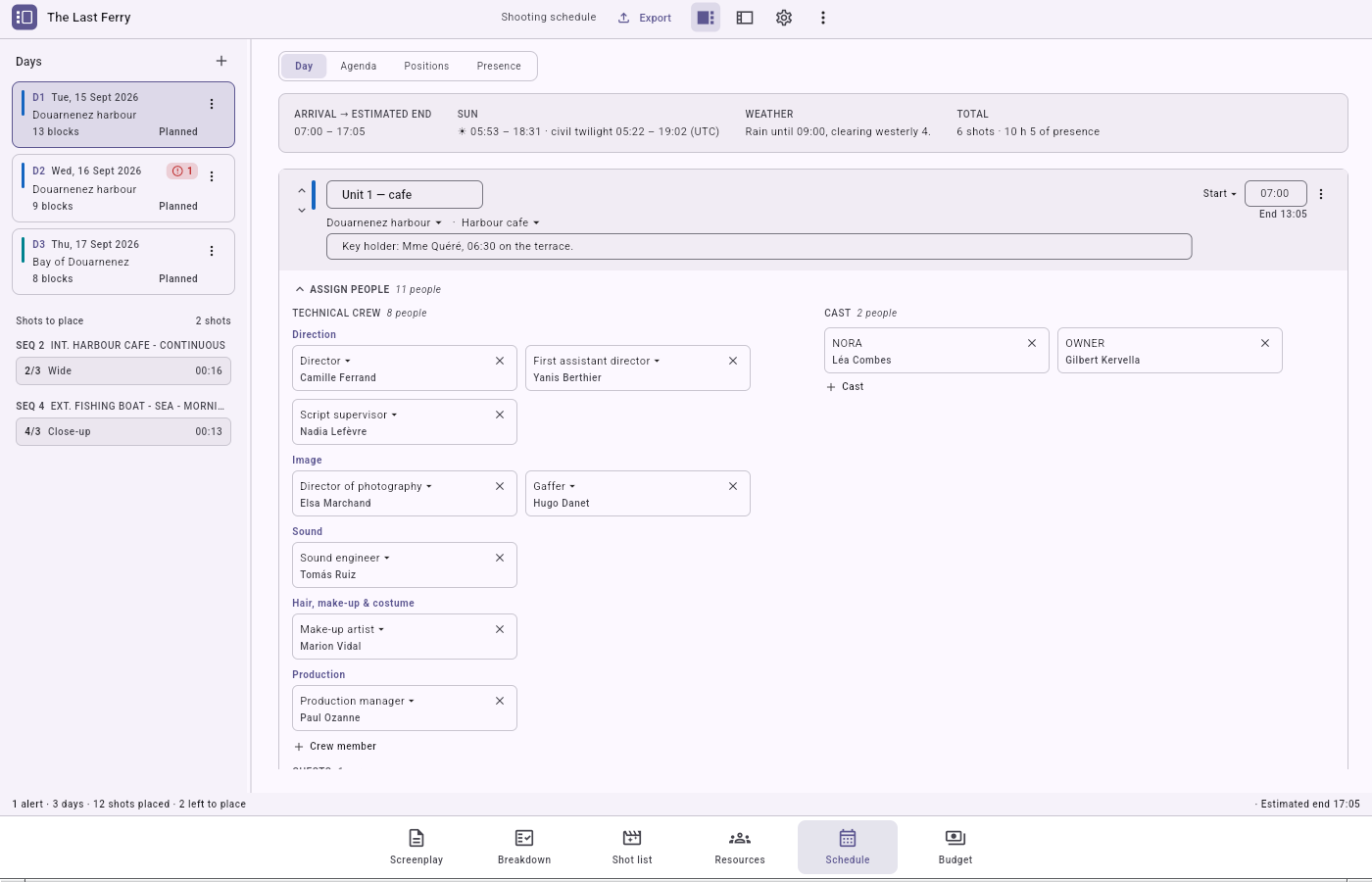
It is the one mode that looks at the whole project at once — every episode together — hence the absence of an episode selector. A single day routinely covers scenes from two episodes at one location.
The objects you work with
- Shooting days. Each day is dated. Its number — the
D3a call sheet prints — is not a fixed label but a rank in date order: re-date a day and the whole schedule renumbers. - Slots. A day holds one or more slots. A slot is a working unit with its own location, crew and hours — often two in a real day (a morning unit, an evening one).
- Blocks. A slot's timetable is made of blocks: shots, holds, rehearsals, auditions, and the time around them (preparation, hair-and-make-up, meals, breaks, travel, wrap). You drag them into place or nudge them in five-minute steps.
- The time model, in plain terms. You never fill in a column of hours. You pin one edge of a slot — "we have the location until 22:00" or "start at first light" — and everything else is computed by chaining the blocks' durations. Nights past midnight are handled. Each block carries a private note (never printed) and a crew note (which does print).
- Events. What the day does not control — the village fireworks at 17:00 — sit at an absolute hour and push nothing.
The four views
- Day view — the working surface. One card per slot, each with an "Assign people" section (crew, cast, guests) and its timetable. This is where you place shots, drag blocks, set a shot's status.
- Agenda — three presentations: a strip (what each day carries), a week hour-grid shaded by sun times, and a month. A "Colour by" control tints days by location or by INT/EXT day/night effect.
- Positions matrix — positions × slots: which position is covered on which unit, each column headed by the slot's resolved hours.
- Presence grid — people × days, with each person's working-day count. Cells are computed (at work, unavailable, or blank) and nothing here is editable.
Call times
A call time is the slot you link the person to. You never type a call time. Link a person, a
role or a guest to a slot, and their hours are read from it: arrival is the earliest slot
start, the PAT band (prêt à tourner — costumed, made up, ready to shoot) runs from the
first to the last Shot or Hold block, and departure is the last slot end. Auditions and
rehearsals never stretch a PAT band: they fall between the arrival and the departure. A person
whose day holds only auditions or rehearsals gets a PRESENCE band over them instead. To bring
an actor in early for make-up, you create a 06:00 slot (labelled HMC) and link them to it — the
file then says exactly what is happening. Guests get an arrival and a departure, but never a band.
The alerts
The mode raises ten kinds of alert. Hard: a person called when unavailable; a person double-booked on two overlapping slots; a slot outside every window its location declares. Soft: a role placed but called on no slot; a role with no actor; an over-run against a pinned edge; a person's day past their maximum; rest short of the project's minimum; a location permit that does not cover the date. Alerts live in a dedicated tab, the status bar carries their count, and each day at fault wears a badge.
The documents
The Schedule produces the documents a production runs on:
- Call sheets (general and named) — one PDF per person; the named one adds its arrival / PAT / departure band and an "À apporter" (things to bring) table.
- Shooting plan (PDF) — the whole shoot: summary grids (locations, scenes, crew/cast, elements) and a per-day agenda.
- Shooting plan (XLSX) — the same plan as an editable spreadsheet, with a chronology sheet.
- Day Out of Days — the cast schedule, one row per role, with SW/W/WF/H codes.
- One-line schedule — a compact strip, one line per scene in shooting order, read as an order with no hours column.
- Sides — the actual screenplay pages of a day's scenes.
Every export lists every day, every hour is the resolved one, and scene numbers already print as
2.12.